+256-702 595 926 | info@bookgorillatracking.com

Western Lowland Gorillas

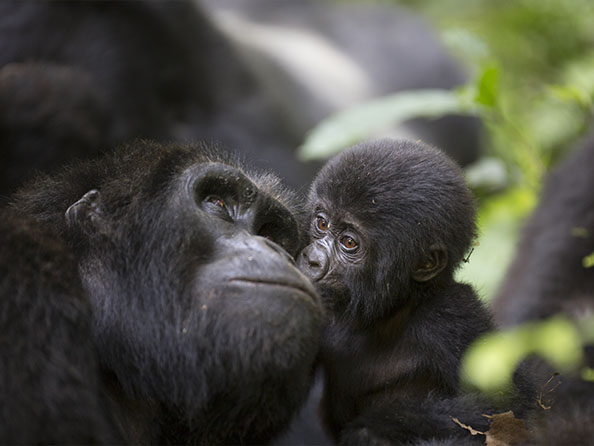
Gorillas are with no doubt star attractions, a good reason why Africa is the most preferred destination for gorilla trekking. The Western lowland gorillas (Gorilla gorilla gorilla) are the smallest of all the 4 sub-species of gorillas and they fall under the Western gorillas. The rest of the 3 subspecies of gorillas include mountain gorillas, Grauer’s gorillas and Cross River gorillas.
Distribution of Western lowland gorillas (Habitat & diet)
The Western lowland gorillas survive in the montane, primary and secondary forest and lowland swampland in Central African countries. The best places to locate lowland gorillas include Cameroon, Republic of the Congo, Central African Republic, Gabon, Equatorial Guinea, Democratic Republic of the Congo (DRC), and Angola.
Over 150,000 western lowland gorillas still survive in the wild. These are distributed across over 700,000sq.km of Central and West Africa. These apes are listed as critically endangered species by IUCN.
Unlike other subspecies of gorillas, the Western lowland gorillas are the only sub-species of gorillas that can be found at the zoos exclusive of Amahoro –a female Eastern lowland gorilla at Antwerp zoo and some mountain gorillas that live in the D.R. Congo. Majority of lowland gorilla’s diet composition is comprised of fruits, tree barks, wild celery, shoots, roots and pulps. At times, these primates feed on termites and ants.
Description
Western lowland gorillas grow shorter black brown hair, long arms and more prominent ridge on their brow. In terms of size, these are the smallest sub-species of gorillas, exhibit pronounced sexual dimorphism. The lowland gorillas do not have tails, possessing jet black skin together coarse black hair covering the whole body exclusive of the ear, face, feet and hands.
The males grow grey coloration and as they grow old, the hair gets lost. Matured males are silverbacks due to the grey coloration on the backs. In terms of strength, they have short muzzles, large nostrils and small eyes and ears. These apes also other distinct traits that make them identical including large muscles in the jaw area together broad and strong teeth.
A male western lowland gorilla can stand high 1.8m and weigh 270kg. At average, males weight about 140kg while females weigh 90kg. In captivity, they can weigh up to 275kg. Often, these apes stand upright and walk in a hunched, quadrupedal fashion, with hands curled and knuckles touching the ground.
Behavior
Western lowland gorillas move within their home range of about 8-45sq.km. Gorillas never display territorial behavior and neighboring families usually overlap ranges. The family often favors a certain part within the home range although this is normally during particular seasons considering availability of ripening frits. On normal occasion, gorillas can travel 3-5km per day. They feed on high-energy foods and these vary depending on the season. They keep around their home range when there is abundant flora, especially during the wet season.
A family is led by a mature male gorilla, also referred to silverback. In a family, there are like 30 members. The leader in the group takes the rest in the day program including feeding, nesting and traveling in their home range.
Reproduction
Like humans, gorillas also give birth to their off-springs. Unlike humans, female western lowland gorillas produce fewer off-springs because they often reach maturity at 8-9 years. Their gestation period goes up to 9 months and gives birth to one infant and on rare occasion twins. During pregnancy, it is hard to ascertain if a female gorilla is pregnant because she never shows signs.
Intelligence
Use of tools: Like humans, gorillas are intelligent and have capability to fashion natural materials into tools to assist them in extracting food stuffs, especially extracting ants and termites.
Communication
Like other gorillas, western lowland gorillas have wide array of vocalizations. Over 22 distinct hoots, screams, barks can be made by gorillas and each communicating something different.