+256-702 595 926 | info@bookgorillatracking.com

Nshongi Gorilla Family in Bwindi, Uganda | Rushaga Trek Guide


Nshongi Gorilla Family in Bwindi Impenetrable National Park, Uganda
Introduction to the Nshongi Gorilla Family
The Nshongi Gorilla Family is one of the remarkable habituated mountain gorilla groups in Bwindi Impenetrable National Park, southwestern Uganda. Located in the park’s Rushaga sector, this family is particularly famous for its history as one of the largest mountain gorilla groups ever habituated for tourism.
Nshongi became internationally recognised because of its unusually large membership and the presence of several mature males living within the same group. At its peak, the family reportedly contained approximately 34–36 individuals, making it exceptional compared with the smaller family groups commonly encountered during gorilla trekking.
Over time, internal competition, dispersal and family splits changed its composition. Two notable groups, Mishaya and Bweza, emerged from the original Nshongi family, adding to the history of gorilla family formation in Bwindi.
Today, Nshongi remains an important group for mountain gorilla conservation and tourism in Uganda. Visitors planning a gorilla trekking safari in Rushaga may have an opportunity to encounter this family, depending on the daily allocation made by Uganda Wildlife Authority (UWA).
Where Is the Nshongi Gorilla Family Located?
The Nshongi Gorilla Family is found in the Rushaga sector of Bwindi Impenetrable National Park, in southwestern Uganda.
Rushaga is situated in the southern part of Bwindi, within the Kisoro area. It is one of the park’s four main gorilla trekking sectors, alongside Buhoma, Ruhija and Nkuringo.
The sector is particularly popular with gorilla trekking visitors because it has several habituated mountain gorilla families. It is also the location of Uganda’s gorilla habituation experience, which allows visitors to spend more time with a gorilla group undergoing habituation.
Bwindi’s mountainous landscape, dense vegetation, steep slopes and forest trails make trekking an exciting but sometimes physically demanding activity. The forest is part of the Albertine Rift ecosystem and provides habitat for mountain gorillas, forest elephants, numerous bird species, monkeys and other wildlife.
Why choose Rushaga for gorilla trekking?
- It provides access to several habituated gorilla families.
- It is the only sector in Bwindi where the gorilla habituation experience is offered.
- It can be combined with visits to Lake Mutanda and other attractions in southwestern Uganda.
- It offers opportunities to explore the southern part of Bwindi and the surrounding highland communities.
- It can be reached from Kampala, Entebbe or Kigali, depending on the itinerary.
History of the Nshongi Gorilla Family
The Nshongi Gorilla Family has a particularly interesting history because of its large original membership and the changes that occurred as individual gorillas matured and competed for social position.
Habituation and opening to tourism
The habituation of the Nshongi group began around 2007. Habituation is a gradual conservation process through which wild gorillas become accustomed to the presence of researchers, trackers and, eventually, tourists.
After several years of monitoring and habituation, the family was officially opened for tourism in September 2009.
Its introduction to gorilla tourism attracted considerable attention because of its exceptional size. Unlike many gorilla groups that have one dominant silverback and a smaller number of members, Nshongi had several mature males and numerous other individuals.
Nshongi’s remarkable original size
The group was reported to have approximately 34–36 members at its peak. This unusually large membership made it one of the biggest habituated mountain gorilla families recorded.
Its social structure was also unusual. Several silverbacks and blackbacks lived within the same group, with relatively little conflict during the period when the family was being observed.
This made Nshongi especially interesting to researchers and visitors interested in mountain gorilla behaviour. It demonstrated that gorilla family structures can be more complex than the common arrangement of one dominant silverback with several females and their offspring.
The split that formed the Mishaya Gorilla Family
In July 2010, the Nshongi group experienced a major split. A section of the family separated under the leadership of a silverback named Mishaya, establishing what became known as the Mishaya Gorilla Family.
Mishaya was known for his assertive behaviour and ability to establish a separate group. His departure marked an important stage in the changing structure of the original Nshongi family.
Mishaya later died on 3 February 2014. Following his death, members of his group dispersed. Some eventually joined other gorilla groups, including Bweza and Bikingi. The remaining members were later rediscovered under the leadership of silverback Tinfayo, and the group underwent further habituation.
The formation of the Bweza Gorilla Family
Another significant split occurred in August 2012, when a section of Nshongi separated to establish the Bweza Gorilla Family.
This development further reduced the size of the original Nshongi group and created another habituated family in the Rushaga sector.
The emergence of Mishaya and Bweza illustrates how mountain gorilla groups change over time. Family splits may occur as young males mature, social relationships change and competition develops between adult males.
For visitors, the history of these related families offers an opportunity to understand the complex social lives of mountain gorillas beyond the one-hour trekking encounter.
Current Size and Leadership of the Nshongi Gorilla Family
The number of gorillas in a family is not permanent. Births, deaths, dispersal, transfers and family splits can all change its membership.
According to the International Gorilla Conservation Programme (IGCP), the Nshongi Gorilla Family had 13 members as of 31 January 2024. The published profile identifies silverback Bweza as the group’s leader.
The recorded family included silverbacks, a blackback, adult females, younger gorillas and infants.
It is important to distinguish this dated record from a live population count. Gorilla family membership can change, so travellers should not rely on older online figures describing the group as having 25, 31 or 36 members as its current size.
The role of the dominant silverback
A silverback is a mature male mountain gorilla distinguished by the silver-grey hair that develops across his back as he reaches adulthood.
The dominant silverback generally plays an important role in protecting and guiding the family. He helps coordinate group movement, responds to potential threats and influences the group’s social relationships.
In Nshongi’s history, the presence of several mature males was particularly remarkable. Its changing membership demonstrates that gorilla leadership and group composition can evolve over time.
What Makes the Nshongi Gorilla Family Special?
There are several reasons why Nshongi is an important mountain gorilla family in Bwindi.
1. Its exceptional historical size
Nshongi is remembered for having approximately 34–36 members at its peak. This made it one of the largest habituated mountain gorilla groups recorded and distinguished it from many other families in Bwindi.
2. Its unusual multi-male social structure
The group was notable for having several silverbacks and blackbacks living together. Their presence provided an interesting example of the social relationships that can exist within mountain gorilla families.
3. Its connection to other gorilla families
The Mishaya and Bweza families originated from Nshongi. Understanding its history therefore helps explain the development of several habituated groups in the Rushaga sector.
4. Its contribution to gorilla tourism
Nshongi was among the early families to open for tourism in southern Bwindi. Its habituation and introduction to visitors helped establish Rushaga as an important destination for mountain gorilla trekking.
5. Its conservation significance
Gorilla tourism contributes to conservation by generating income for protected-area management and creating economic opportunities for communities around Bwindi. The protection of gorillas and their forest habitat also depends on monitoring, research and cooperation between conservation organisations and local communities.
Nshongi Gorilla Family Trekking Experience
Gorilla trekking is one of Uganda’s most rewarding wildlife experiences. Visitors travel through Bwindi’s tropical rainforest accompanied by trained Uganda Wildlife Authority guides and trackers to locate a habituated mountain gorilla family.
If you are interested in seeing the Nshongi Gorilla Family, you should plan your safari around the Rushaga sector.
What happens during the trek?
1. Arrival at the Rushaga briefing centre
Visitors report to the designated visitor information centre early in the morning. UWA staff validate permits and provide information about the trekking activity.
2. Ranger briefing
Before entering the forest, visitors receive instructions about gorilla behaviour, safety, conservation and responsible viewing.
3. Entering Bwindi Forest
The trek begins with experienced guides and trackers leading visitors along forest trails. The terrain can be steep, muddy and uneven, depending on the weather and the location of the gorillas.
4. Searching for the gorillas
Trackers use their knowledge of gorilla movements and the forest to help locate the assigned family. The time required varies depending on where the gorillas have moved.
5. Observing the gorillas
Once the gorillas are located, visitors are allowed a maximum of one hour to observe them during a standard gorilla trekking experience.
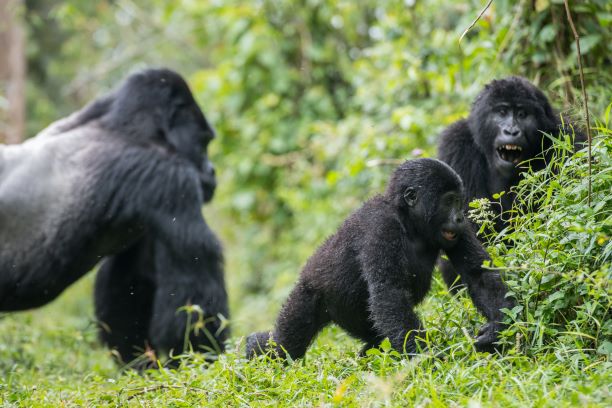
You may see the silverback resting, females feeding, infants playing or younger gorillas interacting with other members of the family. Every encounter is different because the animals move and behave naturally.
6. Returning from the forest
After the viewing period, visitors follow their guides back to the starting point. A successful trek can take several hours, depending on the group’s location and the terrain.
Can you specifically book the Nshongi Gorilla Family?
You can book a gorilla trekking permit for the Rushaga sector, but you should understand how family allocation works.
According to Uganda Wildlife Authority’s July 2024 tracking guidelines, gorilla permits are booked according to the tracking date and designated entry point. Visitors are allocated to a specific gorilla family within the sector on the day of tracking.
Therefore, booking a Rushaga permit does not automatically guarantee that you will visit Nshongi. The final allocation depends on UWA’s arrangements and the operational circumstances on the day.
If Nshongi is the family you are particularly interested in, discuss your preference with your tour operator when planning your safari. The operator can explain the allocation process and help arrange a suitable Rushaga trekking itinerary, without promising a particular family.
How to Book a Nshongi Gorilla Trekking Permit
To trek mountain gorillas in Rushaga, you need a valid gorilla trekking permit issued through the Uganda Wildlife Authority booking system.
A practical booking process involves the following steps:
- Choose your trekking date: Decide when you would like to visit Bwindi.
- Select Rushaga: Request a permit for the Rushaga sector, where the Nshongi family is located.
- Check permit availability: Confirm whether permits are available for your preferred date.
- Provide visitor details: Supply the required passport information and other details requested for the booking.
- Make payment: Complete payment according to the official booking arrangements.
- Receive confirmation: Ensure you receive the appropriate permit confirmation and travel documentation.
Under the UWA guidelines published in July 2024, foreign non-resident permits must be purchased through a tour operator licensed by the Uganda Tourism Board. Travellers should confirm the latest booking requirements and applicable permit fees before making payment.
Important: A gorilla trekking permit allows you to participate in the trekking activity; it does not guarantee an encounter with a named family such as Nshongi.
Best Time to Visit the Nshongi Gorilla Family
Gorilla trekking in Bwindi is available throughout the year. However, some months may offer more convenient hiking conditions than others.
Dry seasons
The relatively drier periods generally occur from June to August and December to February.
These months are popular with visitors because forest trails may be less muddy, although rainfall can occur at any time in Bwindi.
Advantages include:
- Generally more favourable hiking conditions.
- Less muddy trails in some parts of the forest.
- Good opportunities to combine gorilla trekking with other Uganda safari activities.
- Suitable conditions for travellers planning multi-destination itineraries.
Rainy seasons
Bwindi experiences rainfall throughout the year, with wetter periods commonly occurring around March to May and September to November.
During these months, forest trails may become slippery and challenging. However, gorilla trekking continues, and the forest is particularly lush.
Advantages include:
- Beautiful green forest scenery.
- Opportunities to enjoy the rainforest at its lushest.
- Potentially quieter travel periods than the busiest holiday months.
Our recommendation: Choose your trekking date based on your wider travel plans rather than assuming that gorilla sightings are only possible during the dry season. Mountain gorillas live in Bwindi throughout the year, and sightings are not guaranteed on any particular date.
What to Pack for Nshongi Gorilla Trekking
Proper preparation makes a difference when walking through Bwindi’s dense forest.
We recommend carrying:
- Waterproof hiking boots with good grip.
- Long trousers and a long-sleeved shirt.
- A lightweight waterproof jacket or raincoat.
- Gardening gloves for holding vegetation along steep trails.
- A small backpack for personal belongings.
- Drinking water.
- Packed snacks for before or after the gorilla encounter, following ranger instructions.
- Insect repellent.
- Sunscreen.
- A camera with a good zoom lens.
- Extra batteries or a power bank.
- A walking stick, which may be available at the briefing point.
- Personal medication and basic first-aid supplies.
Wear neutral-coloured clothing suitable for forest conditions. Avoid bright colours and strong fragrances.
Visitors should also consider hiring a local porter. Porters can assist with carrying bags and navigating difficult sections of the trail, while providing an additional source of income for people living around the park.
Gorilla Trekking Rules and Regulations
Mountain gorillas are endangered wildlife and require responsible protection. Visitors must follow the instructions provided by Uganda Wildlife Authority guides and trackers.
Important guidelines include:
- The minimum age for gorilla trekking in Uganda is 15 years.
- Standard gorilla trekking allows a maximum of one hour with the gorillas.
- Maintain the distance instructed by your ranger.
- Avoid loud noises and sudden movements.
- Do not touch the gorillas, even if they approach you.
- Do not eat, drink or smoke while observing the gorillas.
- Never leave rubbish in the forest.
- Do not use flash photography.
- Avoid trekking when you are sick, especially with a contagious respiratory illness.
- Follow all instructions from your guides and trackers.
These guidelines protect both visitors and gorillas. Mountain gorillas are vulnerable to human diseases, so responsible tourism is essential.
Other Activities to Combine with Nshongi Gorilla Trekking
A gorilla trekking safari in Rushaga can be combined with other attractions in southwestern Uganda.
Lake Mutanda
Lake Mutanda is a beautiful freshwater lake near Kisoro, surrounded by rolling hills and views of the Virunga Volcanoes. Visitors can enjoy canoeing, boat excursions, photography and relaxing at lakeside accommodation.
Lake Bunyonyi
Lake Bunyonyi is one of Uganda’s most scenic lakes, known for its numerous islands and surrounding terraced hills. It is a good destination for relaxation before or after a gorilla trekking adventure.
Batwa Cultural Experience
The Batwa are among the indigenous communities historically associated with the forests of southwestern Uganda. A guided cultural experience can introduce visitors to aspects of Batwa history, traditional forest knowledge, music and cultural practices.
Choose responsible community experiences that respect local people, their knowledge and their cultural heritage.
Golden Monkey Tracking in Mgahinga
Travellers with additional time can visit Mgahinga Gorilla National Park for golden monkey tracking. The park is part of the Virunga landscape and offers another memorable primate experience.
Volcanoes National Park in Rwanda
For visitors combining Uganda and Rwanda, Volcanoes National Park offers opportunities for mountain gorilla trekking, golden monkey tracking and volcano hiking. A cross-border safari can include both countries, subject to the applicable border and permit arrangements.
Where to Stay When Trekking in Rushaga
There are several accommodation options around the Rushaga sector, ranging from budget lodges and guesthouses to comfortable mid-range and luxury properties.
Choosing accommodation close to the Rushaga briefing centre can make the morning of your trek easier, especially when you have an early reporting time.
When selecting a lodge, consider:
- Distance from the Rushaga visitor information centre.
- Room comfort and facilities.
- Availability of meals before and after trekking.
- Transport arrangements to the briefing point.
- Views of Bwindi Forest and the surrounding highlands.
- Your preferred accommodation budget.
We recommend confirming your lodge location before booking because accommodation described as being in the wider Bwindi or Kisoro area may still require a significant transfer to Rushaga.
Frequently Asked Questions About the Nshongi Gorilla Family
1. Where is the Nshongi Gorilla Family found?
The Nshongi Gorilla Family is found in the Rushaga sector of Bwindi Impenetrable National Park in southwestern Uganda.
2. How many gorillas are in the Nshongi Gorilla Family?
The International Gorilla Conservation Programme recorded 13 members in January 2024. This is a dated published count, and the group’s membership may have changed since then.
3. Who leads the Nshongi Gorilla Family?
The IGCP family profile identifies silverback Bweza as the group’s leader in its record updated on 31 January 2024. Leadership can change, so this should not be treated as a live update.
4. Why is the Nshongi Gorilla Family famous?
Nshongi is famous for its unusually large historical size. It reportedly reached approximately 34–36 members and had several mature males living within the same group.
5. Which gorilla families split from Nshongi?
The Mishaya Gorilla Family split from Nshongi in July 2010, while the Bweza Gorilla Family separated in August 2012, according to IGCP.
6. Can I book a permit specifically for Nshongi?
You can book a gorilla trekking permit for the Rushaga sector, but UWA allocates visitors to a particular family on the trekking day. A named family cannot be guaranteed simply by booking a sector permit.
7. How long does Nshongi gorilla trekking take?
The entire trekking experience may take approximately 2–7 hours, depending on the location of the gorillas, terrain and forest conditions. Once the gorillas are found, standard trekking allows a maximum of one hour of viewing.
8. What is the minimum age for Nshongi gorilla trekking?
The minimum age for mountain gorilla trekking in Uganda is 15 years.
9. Is Nshongi the largest gorilla family in Bwindi?
Nshongi was historically one of the largest habituated mountain gorilla groups recorded, with approximately 34–36 members at its peak. It should not be described as the current largest family because its membership has changed over time.
10. Can I combine Nshongi gorilla trekking with other Uganda safari activities?
Yes. You can combine a Rushaga gorilla trek with visits to Lake Mutanda, Lake Bunyonyi, Mgahinga Gorilla National Park and other destinations in southwestern Uganda.
Plan Your Nshongi Gorilla Trekking Safari with Book Gorilla Tracking
The Nshongi Gorilla Family offers a fascinating insight into mountain gorilla history, social behaviour and conservation in Bwindi Impenetrable National Park. From its remarkable original size to the formation of the Mishaya and Bweza families, Nshongi remains an important part of Uganda’s gorilla tourism story.
If you are planning a mountain gorilla trekking adventure in Uganda, Book Gorilla Tracking can help you organise a safari to Bwindi’s Rushaga sector. We can assist with permit arrangements, accommodation, ground transportation and a personalised itinerary based on your travel dates and budget.
Whether you are planning a short gorilla trekking trip or a longer Uganda safari, contact our team to begin organising your journey.
Plan your Uganda gorilla trekking safari: https://bookgorillatracking.com/contact/
Explore more about Bwindi Impenetrable National Park and discover our 4 Days Bwindi Gorillas and Lake Bunyonyi Safari.