+256-702 595 926 | info@bookgorillatracking.com

Facts About Mountain Gorillas: Complete Gorilla Trekking Guide

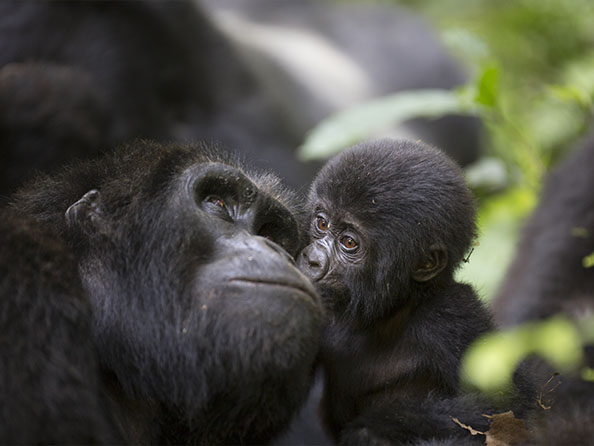
Facts About Mountain Gorillas: Complete Guide to Mountain Gorillas
Mountain gorillas are among Africa’s most remarkable wildlife species. Powerful yet gentle, intelligent yet shy, these endangered primates have become one of the world’s most sought-after wildlife experiences.
Scientifically known as Gorilla beringei beringei, the mountain gorilla is a subspecies of the eastern gorilla. They live in the high-altitude forests of the Albertine Rift, where dense vegetation, steep slopes and cool temperatures create their natural habitat.
For travelers planning a gorilla trekking safari in Africa, understanding these fascinating animals makes the experience even more meaningful. From their social behavior and family structure to their habitat and conservation, there is much more to mountain gorillas than their impressive size.
What Are Mountain Gorillas?
Mountain gorillas are a subspecies of eastern gorilla found only in the mountainous forests of Uganda, Rwanda and the Democratic Republic of Congo (DRC).
Unlike some other great apes, mountain gorillas do not naturally occur across a large geographical range. Their remaining habitat is concentrated in two areas: the Virunga Massif, shared by Uganda, Rwanda and the DRC, and Uganda’s Bwindi Impenetrable Forest.
They are covered with thick, dark fur that helps them cope with the cool temperatures of their high-altitude environment. Their bodies are adapted for life on steep, forested mountain slopes.
Although mountain gorillas are physically powerful, they are generally peaceful animals when left undisturbed. Their complex social groups, close family relationships and expressive behavior make them fascinating to observe in the wild.
How Many Mountain Gorillas Are Left in the Wild?
The mountain gorilla population has recovered significantly from historical declines, thanks largely to intensive conservation efforts, habitat protection, veterinary intervention and responsible tourism.
The often-quoted figure of approximately 1,063 mountain gorillas comes from combining the 2018 Bwindi population estimate with the 2015 Virunga census. It is therefore better treated as an important historical population benchmark rather than a precise current global count.
Conservation organizations continue to monitor mountain gorilla populations, and the species remains endangered.
One of the most important conservation successes is that visitors can contribute directly to gorilla conservation through regulated gorilla trekking. Permit revenue, tourism employment and community programs all help create economic incentives for protecting gorilla habitat.
Where Do Mountain Gorillas Live?
Mountain gorillas live in only three countries:
- Uganda
- Rwanda
- Democratic Republic of Congo
Their habitat is concentrated in two major ecosystems.
The first is the Virunga Massif, a chain of volcanic mountains shared by Uganda, Rwanda and the DRC.
The second is Bwindi Impenetrable National Park in Uganda, which contains a separate mountain gorilla population.
Mountain Gorillas in Uganda
Uganda is one of the best destinations for mountain gorilla trekking in Africa. The country has two national parks where mountain gorillas can be found:
Bwindi Impenetrable National Park
Bwindi is Uganda’s primary mountain gorilla trekking destination. The ancient rainforest is located in southwestern Uganda and is home to a significant portion of the world’s remaining mountain gorillas.
Gorilla trekking takes place in four main sectors:
Each sector has its own habituated gorilla families available for trekking. The terrain and trekking experience can vary considerably between sectors, which is why choosing the right sector is an important part of planning a Uganda gorilla safari.
Bwindi can also be combined with other Ugandan attractions such as Queen Elizabeth National Park, Kibale Forest, Lake Mburo and Murchison Falls.
Mgahinga Gorilla National Park
Mgahinga is Uganda’s smallest national park and forms part of the larger Virunga Conservation Area.
The park is located in the Kisoro region of southwestern Uganda and protects a section of the Virunga volcanic mountains.
Mgahinga is home to mountain gorillas and offers an excellent alternative to Bwindi for travelers who want to combine gorilla trekking with a quieter mountain environment.
Mountain Gorillas in Rwanda
Rwanda’s mountain gorillas live exclusively in Volcanoes National Park, in the northwestern part of the country.
Volcanoes National Park forms part of the Virunga Massif and is one of Africa’s most famous gorilla trekking destinations.
One of Rwanda’s biggest advantages is accessibility. The park can be reached from Kigali in roughly 2–3 hours by road, making it particularly convenient for travelers with limited time.
Rwanda has also invested heavily in tourism infrastructure, conservation and visitor management. Gorilla trekking permits are more expensive than those in Uganda, but the combination of accessibility, high-quality accommodation and organized tourism makes Rwanda a popular choice for travelers seeking a premium gorilla safari.
Gorilla trekking in Rwanda can also be combined with experiences such as golden monkey trekking, cultural visits and wildlife safaris in Akagera National Park.
Mountain Gorillas in the Democratic Republic of Congo
The Democratic Republic of Congo is the third country where mountain gorillas can be seen in the wild.
Mountain gorillas live in Virunga National Park, which forms part of the Virunga Massif.
The DRC is also home to eastern lowland gorillas, particularly in Kahuzi-Biega National Park. However, eastern lowland gorillas are different from mountain gorillas, so travelers should not confuse the two species when planning a gorilla experience in the DRC.
Because conditions and park operations in eastern DRC can change, travelers should obtain current security and operational information before planning a Virunga gorilla trek.
10 Fascinating Facts About Mountain Gorillas
1. Mountain gorillas are among the largest living primates
Mountain gorillas are extremely powerful animals. Adult males, particularly dominant silverbacks, can weigh well over 150 kilograms, while females are considerably smaller.
Their muscular bodies, large hands and powerful arms are adaptations to their forest environment.
2. They live in close-knit family groups
Mountain gorillas are highly social animals.
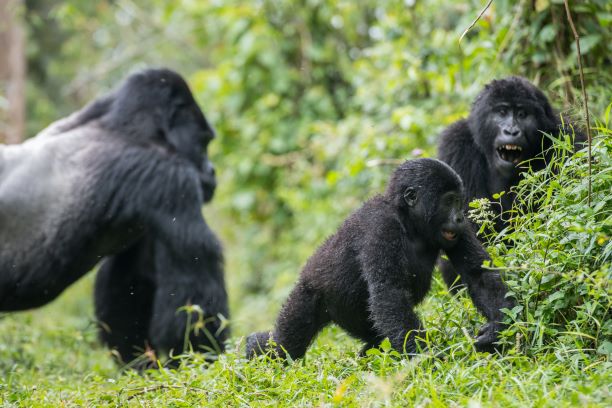
A typical gorilla group consists of a dominant silverback, females, younger males, infants and juveniles. The dominant silverback provides leadership and protection while maintaining order within the group.
Gorilla families develop strong social bonds, making their interactions fascinating to observe during trekking.
3. Silverbacks are mature male gorillas
The term “silverback” refers to an adult male gorilla that develops distinctive silver-gray hair across its back as it matures.
The silverback is often the dominant member of a gorilla family and plays an important role in protecting the group, resolving conflicts and leading movements through the forest.
4. Mountain gorillas are mostly vegetarian
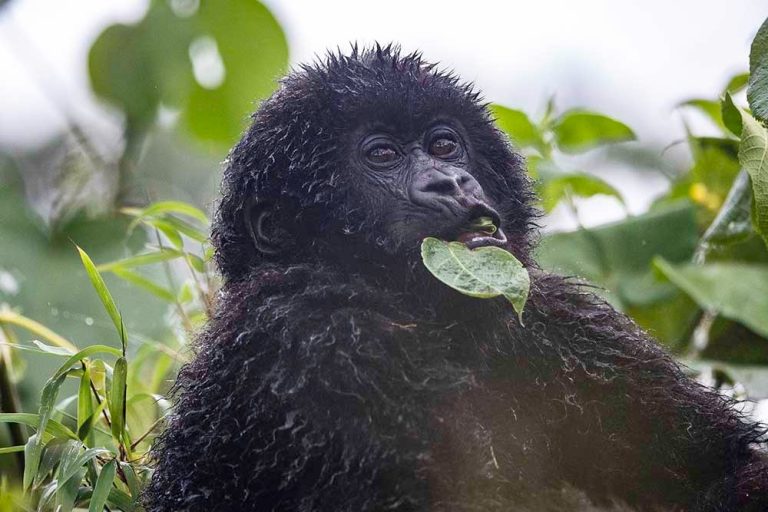
Their diet consists primarily of leaves, shoots, stems, roots, flowers and other vegetation.
Because their habitat contains abundant plant life, mountain gorillas spend a significant amount of time feeding and moving through the forest in search of suitable vegetation.
5. They have distinctive nose prints
Just as humans have unique fingerprints, gorillas have distinctive nose patterns.
Researchers and conservationists can use these physical characteristics, together with other features, to help identify individual gorillas.
6. Mountain gorillas communicate in many ways
Gorillas communicate using a combination of vocalizations, body postures, facial expressions, gestures and physical contact.
Their communication helps maintain relationships, establish dominance, express alarm and coordinate activities within the group.
Although gorillas are highly intelligent and have demonstrated impressive learning abilities in captivity, claims that wild gorillas communicate with tourists through human sign language are misleading.
7. They build nests for sleeping
Mountain gorillas usually construct nests from vegetation for sleeping.
Depending on their age and circumstances, gorillas may build nests on the ground or in trees. Infants may sleep close to their mothers for protection.
8. Mountain gorillas live in cold, high-altitude forests
Their habitat is characterized by steep slopes, dense vegetation and relatively cool temperatures.
Their thick fur is particularly useful in helping them cope with the cooler mountain environment.
9. Gorilla families can change over time
Gorilla groups are not permanently fixed.
Individuals can leave or join other groups, and young males may eventually leave their natal group and establish or join another social group.
These changes contribute to the complex social structure of mountain gorilla populations.
10. Gorilla tourism helps conservation
One of the most important facts about mountain gorillas is that responsible tourism has become an important part of their conservation story.
Gorilla permits generate revenue that supports protected areas, conservation programs and local communities. Tourism also provides employment for guides, trackers, rangers, porters, drivers and hospitality workers.
For this reason, choosing a responsible local tour operator and following park regulations is an important part of supporting gorilla conservation.
What Is Mountain Gorilla Trekking?
Mountain gorilla trekking is a guided wildlife experience in which visitors hike through the forest in search of a habituated gorilla family.
The experience normally begins in the morning with a briefing from park officials and guides. Visitors are assigned to a gorilla family and then enter the forest with experienced trackers and rangers.
The trek can take anywhere from a few hours to most of the day depending on where the gorilla family has moved.
Once the gorillas are located, visitors are allowed a regulated period of observation, normally up to one hour for standard gorilla trekking.
The experience is not simply about finding gorillas. The journey through the forest, the scenery, birdlife, plants and other wildlife are all part of the adventure.
How Difficult Is Gorilla Trekking?
Gorilla trekking can be physically demanding.
The forests are mountainous, and visitors may encounter steep slopes, muddy trails, dense vegetation and uneven ground. Trekking time varies depending on the location of the gorilla family on the day.
Fitness is helpful, but you do not need to be an experienced mountaineer.
Travelers who are concerned about the physical demands can hire a porter to assist with their daypack and provide support along difficult sections of the trail.
Choosing the right trekking sector can also make a difference, particularly for travelers with limited mobility or lower fitness levels.
Gorilla Trekking Permit Prices
Gorilla trekking permits vary between Uganda, Rwanda and the Democratic Republic of Congo.
| Destination | Standard Gorilla Trekking Permit |
|---|---|
| Uganda | From US$800 for foreign non-residents |
| Rwanda | US$1,500 for international visitors |
| Democratic Republic of Congo | Prices and availability should be confirmed before travel |
Permit prices can change according to tourism authority tariffs, visitor category and season. Travelers should always confirm the current price and availability before making a booking.
Uganda Gorilla Habituation Experience
Uganda offers a special experience known as the Gorilla Habituation Experience.
Instead of spending the standard limited viewing period with a fully habituated gorilla family, participants spend substantially longer with a gorilla group undergoing the habituation process.
This experience is particularly attractive to photographers, researchers and travelers who want a deeper understanding of gorilla behavior.
It is available in the Rushaga sector of Bwindi Impenetrable National Park and requires a separate permit.
Best Time for Mountain Gorilla Trekking
Mountain gorilla trekking is available throughout the year.
However, many travelers prefer the relatively drier periods because forest trails can be easier to navigate.
The drier months are generally considered around June to September and December to February, while March to May and parts of October to November can experience heavier rainfall.
That said, rainforests can receive rain at any time of year. The wet seasons can also provide lush vegetation and fewer visitors, and gorilla trekking remains possible.
For travelers looking for better value, it is worth discussing the different seasons with a local safari operator before booking.
What to Pack for Gorilla Trekking
A good packing list can make your gorilla trekking experience considerably more comfortable.
Consider bringing:
- Waterproof hiking boots
- Long trousers
- Long-sleeved shirts
- Waterproof rain jacket
- Gardening or hiking gloves
- Lightweight daypack
- Insect repellent
- Reusable water bottle
- Hat and sunscreen
- Camera and spare batteries
- Walking stick
- Snacks
- Waterproof protection for electronics
Because Bwindi and the Virunga region are rainforest environments, rain protection is particularly important.
Mountain Gorilla Trekking Rules
Gorilla trekking is carefully regulated to protect both visitors and gorillas.
Visitors should:
- Follow instructions from guides and park rangers.
- Keep a respectful distance from gorillas.
- Avoid making loud noises or sudden movements.
- Never attempt to touch a gorilla.
- Do not feed the gorillas.
- Avoid trekking when seriously ill.
- Follow photography rules.
- Do not leave rubbish in the forest.
- Respect the allocated viewing time.
These rules are designed to minimize stress, disease transmission and behavioral disturbance.
Why Mountain Gorilla Conservation Matters
Mountain gorillas were once under severe pressure from habitat loss, poaching, disease and other human-related threats.
Today, conservation efforts involving governments, protected-area authorities, researchers, conservation organizations and local communities have helped improve their outlook.
Gorilla tourism has become an important part of this conservation model.
When you purchase a gorilla trekking permit, your money contributes to a tourism system that supports protected areas and local livelihoods. Hiring local guides, porters and accommodation providers further spreads tourism benefits into surrounding communities.
This is one reason gorilla trekking is more than simply a wildlife holiday. It can directly contribute to protecting one of the world’s most endangered great apes.
Uganda, Rwanda or Congo: Which Is Best for Gorilla Trekking?
There is no single best destination for every traveler.
Uganda is particularly attractive for travelers looking for a wider safari experience, competitive gorilla permit prices and the option of the Gorilla Habituation Experience. Uganda also makes it easy to combine gorilla trekking with chimpanzee trekking, savannah wildlife and birding.
Rwanda is ideal for travelers who prioritize convenience, accessibility and a premium safari experience. Volcanoes National Park is relatively close to Kigali and offers excellent infrastructure and accommodation.
The Democratic Republic of Congo offers a more adventurous experience in Virunga, although travelers must carefully consider current security conditions and park operations before booking.
The best destination ultimately depends on your budget, travel time, fitness, accommodation preferences and the other wildlife experiences you want to include.
Can You Combine Gorilla Trekking With a Wildlife Safari?
Absolutely.
A gorilla trek can form the centerpiece of a longer East African safari.
In Uganda, popular combinations include:
- Gorilla trekking + Queen Elizabeth National Park
- Gorilla trekking + Kibale Forest chimpanzee trekking
- Gorilla trekking + Murchison Falls National Park
- Gorilla trekking + Lake Mburo National Park
- Gorilla trekking + birding in Bwindi
- Gorilla trekking + golden monkey trekking in Mgahinga
In Rwanda, travelers can combine gorilla trekking with Akagera National Park or Nyungwe National Park.
This allows visitors to experience much more than primates, including elephants, lions, buffaloes, hippos, antelopes, birds, forests and savannah landscapes.
Frequently Asked Questions About Mountain Gorillas
How many mountain gorillas are left?
The commonly cited population figure is approximately 1,063, based on the 2015 Virunga census and 2018 Bwindi census. Because these surveys are not a single current census, the figure should be treated as a historical benchmark rather than an exact 2026 population count.
Where can I see mountain gorillas?
Mountain gorillas can be seen in Uganda, Rwanda and the Democratic Republic of Congo. Uganda has Bwindi Impenetrable National Park and Mgahinga Gorilla National Park, Rwanda has Volcanoes National Park, and the DRC has Virunga National Park.
How long do you spend with mountain gorillas?
Standard gorilla trekking normally allows visitors up to one hour with the gorilla family once it has been located.
Is gorilla trekking difficult?
Gorilla trekking can be physically demanding because the habitat is mountainous and forest trails can be steep, muddy and uneven. The actual difficulty depends on the gorilla family’s location on the day.
How much does a gorilla permit cost?
Permit prices depend on the country and visitor category. Uganda’s standard permit for foreign non-residents is currently priced at US$800 under the applicable tariff period, while Rwanda’s international permit is US$1,500.
Which country is cheaper for gorilla trekking?
Uganda generally offers a lower standard gorilla trekking permit price than Rwanda for international visitors. The total safari cost, however, also depends on accommodation, transportation, number of days and other activities.
Can I do gorilla habituation in Rwanda?
The specialized Gorilla Habituation Experience is a Uganda offering, conducted in Bwindi Impenetrable National Park.
Plan Your Mountain Gorilla Safari
Mountain gorilla trekking is one of the most extraordinary wildlife experiences in Africa. Walking through an ancient rainforest, following trackers through the mountains and eventually coming face-to-face with a wild gorilla family is an experience that is difficult to compare with any other safari.
Whether you choose Uganda, Rwanda or the Democratic Republic of Congo, planning ahead is essential because gorilla permits are limited and must be secured for a specific trekking date.
For travelers who want more than just gorilla trekking, Uganda is especially rewarding because a gorilla safari can be combined with chimpanzee trekking, Big Five wildlife, birding, cultural experiences and scenic landscapes.
The best safari is not necessarily the one with the highest price. It is the one designed around your interests, available time, preferred accommodation and the kind of African experience you want to remember.
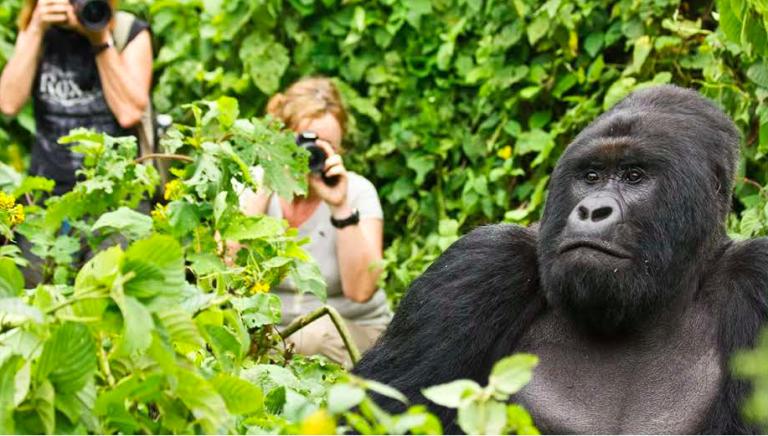
[…] Mountain gorilla trekking is the leading wildlife experience for many visitors to Musanze. Volcanoes National Park protects a population of endangered mountain gorillas living in the forested slopes of the Virunga Mountains. […]